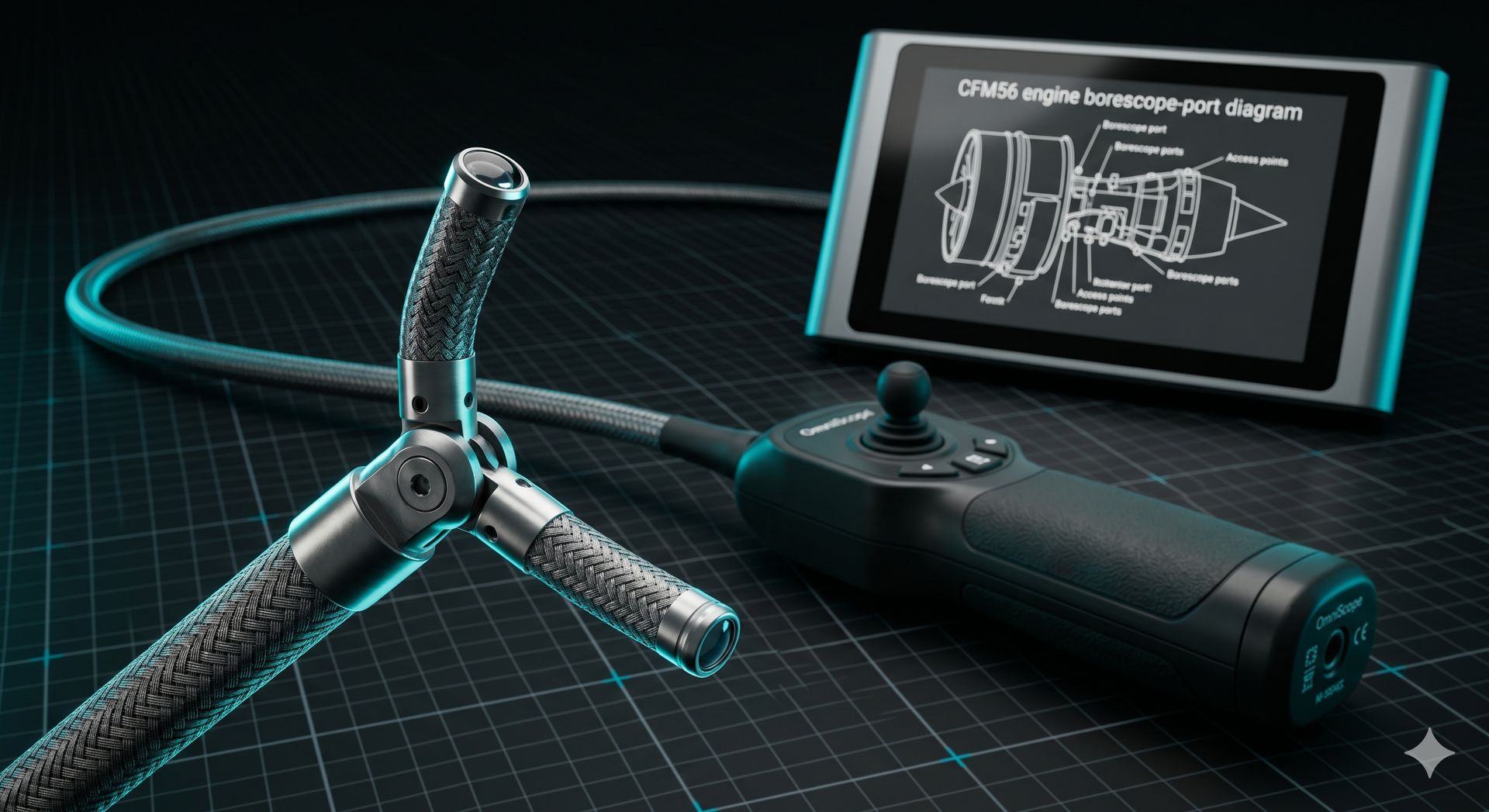
OmniScope M1
4.0mm 4-Way Articulating Portable Videoscope for Confined-Access NDT
- Probe Diameter
- 4.0 mm
- Articulation
- 4-Way TrueGlide (130° Up/Down/Left/Right)
- Resolution
- 0.78 Megapixel (1024 × 768)
- Cable Length
- 3.5 m
Product Overview
The Sugia OmniScope M1 is the entry point to the 4-way articulation platform, combining a 4.0 mm micro-diameter probe with 130° TrueGlide electronic articulation in all four cardinal directions. This diameter class is the industry standard for accessing compressor and turbine borescope ports on CFM International CFM56, IAE V2500, GE CF34, and Rolls-Royce Tay-family powerplants without port-plug modification.
The M1’s articulation mechanism uses four independent shape-memory-alloy (SMA) tension wires per axis, driven by brushless DC micro-motors in the handpiece. The TrueGlide control algorithm samples joystick position at 200 Hz and applies velocity-ramp smoothing to eliminate tip overshoot — critical when inspecting ceramic thermal-barrier coatings (TBCs) where probe contact can cause coating spallation.
The 4.0 mm probe houses a 1/12-inch CMOS sensor delivering 1024 × 768 pixel still images (approximately 0.78 megapixels) with an 85° diagonal field of view. The optical system is optimized for a 5 mm to 120 mm working-distance range, covering the tight standoff distances encountered in cooled turbine-blade internal cooling-passage inspections where the blade pressure-side wall may be only 3–5 mm from the probe tip.
Key Engineering Features
- 4-Way TrueGlide SMA Articulation: Four independent shape-memory-alloy tension actuators with 200 Hz closed-loop position feedback; 130° maximum deflection in each cardinal direction with simultaneous multi-axis blending for omnidirectional steering.
- Micro-Diameter 4.0 mm Probe: Compatible with standard 4.8–5.0 mm borescope access ports without port-plug adapters; tungsten-braided outer jacket with ETFE overbraid for chemical resistance to engine oils and Skydrol hydraulic fluid.
- TBC-Safe Velocity Ramping: Proprietary tip-velocity smoothing algorithm limits maximum articulation rate to 40°/s with S-curve acceleration profile, preventing probe-tip impact against fragile ceramic thermal-barrier coatings.
- 5–120 mm Optimized Optics: Fixed-focus lens group with depth-of-field prioritized for near-field (5–50 mm) sharpness; diffraction-limited performance at f/4.5 equivalent aperture.
- Compact Handpiece: 180 mm × 65 mm × 45 mm handpiece dimensions; 340 g grip weight for single-handed operation during overhead and inverted borescope-port access on wing-mounted engines.
Technical Specifications
| Parameter | Value |
|---|---|
| Probe Outer Diameter | 4.0 mm |
| Insertion Tube Length | 3.5 m |
| Articulation | 4-way TrueGlide electronic (Up/Down/Left/Right) |
| Max Deflection per Axis | 130° |
| Articulation Control | 200 Hz closed-loop joystick with velocity smoothing |
| Image Sensor | 1/12-inch Color CMOS |
| Effective Pixels | 1024 × 768 (0.78 Megapixel) |
| Frame Rate | 30 fps |
| Field of View | 85° diagonal |
| Depth of Field | 5 mm – 120 mm |
| Minimum Bend Radius | 25 mm |
| Illumination | White LED, 5-stage, auto-gain |
| Monitor (Main Unit) | 6.5-inch TFT LCD, 1024 × 768 |
| Storage | SDHC UHS-I, up to 64 GB |
| Video Output | Micro-HDMI Type D |
| Battery | 7.4 V Li-ion, 48 Wh, ~3.5 h runtime |
| Ingress Protection | Probe tip IP67, main unit IP55 |
| Operating Temperature | -15 °C to +50 °C |
| System Weight | 2.3 kg (main unit + probe + battery) |
Target Applications
- Aircraft Engine Maintenance: Compressor blade leading-edge FOD assessment, turbine-blade TBC condition documentation, combustion-chamber liner crack surveys, fuel-nozzle coking inspection on CFM56-5B/-7B and IAE V2500-A5 powerplants.
- Aircraft Airframe: Wing spar internal corrosion surveys through lightening-hole access, stabilizer torque-box internal structure inspection, landing-gear trunnion internal bore examination.
- Small-Bore Industrial Piping: Instrumentation tube internal blockage identification, hydraulic control-line internal corrosion assessment, pneumatic sense-line condensate surveys.
- Medical Device Manufacturing QA: Endoscope instrument-channel internal surface finish verification, catheter lumen inspection, implantable-device internal weld-bead profiling.
Aviation Turbine Inspection Videoscope Workflow
Deployed as an aviation turbine inspection videoscope, the M1 maps directly to line-station task cards for CFM56-5B/-7B and V2500-A5 powerplants: compressor-borescope-port entry, HPT stage-1 nozzle guide-vane survey, and LPT blade-tip-clearance documentation. The 4.0 mm probe matches the OEM access-port diameter, and the 200 Hz TrueGlide velocity smoothing preserves ceramic thermal-barrier coatings during tip repositioning. For maintenance organizations seeking a GE Mentor Flex alternative videoscope, the M1 delivers equivalent 4-way articulation range, interchangeable probe lengths, and SDHC image archival in a portable form factor — without proprietary software lock-in.
Focus Keywords