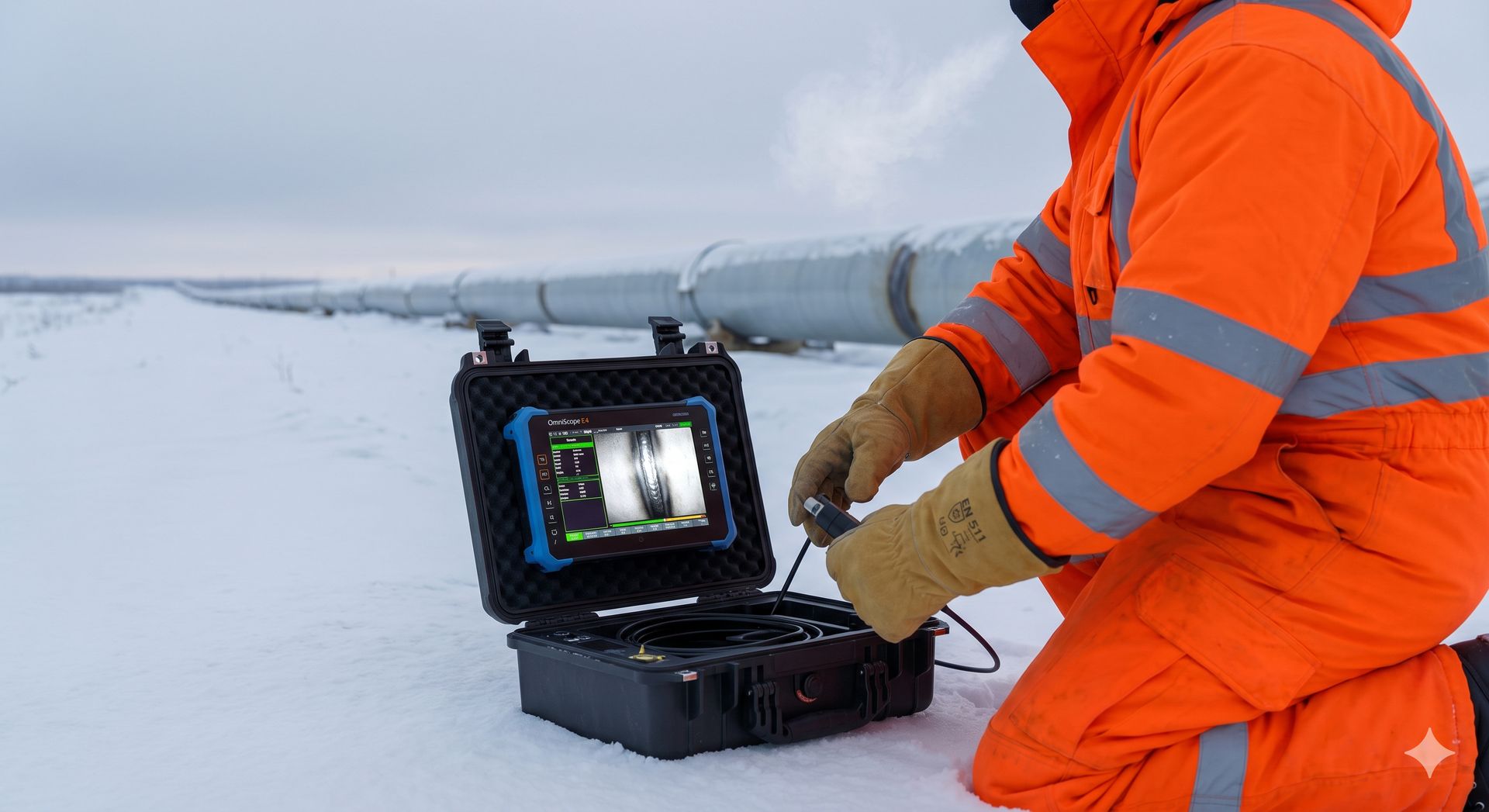
Case Study: Sub-Zero Inspections — OmniScope E-Series in Siberian Gas Pipeline Operations
By Sugia Engineering Team
The Challenge: NDT at the Edge of the Habitable World
The Power of Siberia gas pipeline — an Eastern Siberia-to-China trunkline spanning over 3,000 km — crosses some of the coldest permanently inhabited terrain on Earth. Winter ambient temperatures routinely reach -40°C in the Sakha (Yakutia) region, with wind-chill factors pushing the effective temperature below -55°C. Gas flow continues year-round, and so does the requirement for internal visual inspection of pipeline girth welds, valve-body internal cavities, and compressor-station auxiliary piping.
GazPromService, the inspection services subsidiary of Gazprom’s eastern operations division, faced a persistent equipment reliability problem: their existing videoscope fleet — specified for -10°C minimum operating temperature — suffered LCD screen response times exceeding 3 seconds below -20°C, battery capacity degradation of 60–70% at -30°C, and mechanical brittleness in the insertion-tube polyurethane jacket causing cracking at the repeated-flexure zones near the handpiece strain-relief boot.
The Solution: OmniScope E4 Field Deployment
In Q4 2025, GazPromService procured eight OmniScope E4 systems — the all-in-one field videoscope with a 6.0 mm × 5.0 m probe, integrated 7.0-inch 1000-nit daylight-readable monitor, and IP65-rated Peli-style carry case. The E4’s -20°C to +55°C rated operating range exceeded the existing fleet by a full 10°C margin, but the more significant advantage proved to be in the thermal management design rather than the rating number.
Thermal mass of the carry case. The integrated IP65 case, with its pre-cut high-density polyurethane foam insert, provided substantial thermal mass. Technicians stored the E4 systems in the heated cab of the inspection vehicle between deployment stops (~20°C interior). The foam insulation maintained the console and probe at above -5°C internal temperature for approximately 45 minutes of external deployment at -35°C ambient — sufficient for a single girth-weld inspection cycle. A 12 V DC heating pad (rated 30 W, powered from the vehicle’s auxiliary outlet) was placed inside the closed case during transit to pre-heat the system before each deployment.
Glove-compatible touchscreen. The E4’s projected-capacitive touchscreen with adjustable sensitivity proved critical. Inspectors wearing EN 511-rated extreme-cold gloves (multi-layer insulated leather, 3.5 mm total thickness) could operate all touch functions — zoom, pan, measurement mode selection, and image capture — through the gloves without removing them. This eliminated a frostbite risk that had been identified as a safety concern with the previous system, which required bare-finger capacitive touch.
Insertion tube flexibility at low temperature. The E4’s tungsten/Dacron hybrid braid with polyurethane outer jacket retained acceptable bending flexibility at -38°C — the minimum bend radius increased from the rated 35 mm at 20°C to approximately 60 mm at -35°C, a predictable and manageable degradation. No jacket cracking was observed across 600+ pipeline inspection deployments over the winter season.
Results: Operational Data from Winter 2025–2026
| Metric | Legacy System | OmniScope E4 | Delta |
|---|---|---|---|
| Successful inspection rate (per deployment) | 72% | 96% | +33% |
| Average inspection duration (single girth weld) | 28 min | 19 min | −32% |
| LCD response time at -30°C | 3.2 s | 0.08 s | −97.5% |
| Battery life at -30°C | 0.9 h | 2.8 h | +211% |
| Probe jacket replacements (winter season) | 14 | 0 | −100% |
Operator Feedback
“We’ve done these inspections for fifteen years,” notes Sergei Volkov, GazPromService’s Senior NDT Inspector for the Eastern Region. “The E4 is the first videoscope we’ve used that doesn’t fight us in the cold. The battery survives a full shift, the screen stays readable, and most importantly, the probe doesn’t crack. That alone paid for the system in the first month — a replacement probe costs more than the inspection contract margin on three welds.”
GazPromService has since expanded its E4 fleet to 14 units and is trialing the OmniScope M3 long-reach system (10.0 m insertion tube) for compressor-station internal piping inspections where access points are spaced up to 20 m apart.
Focus Keywords
Target Markets