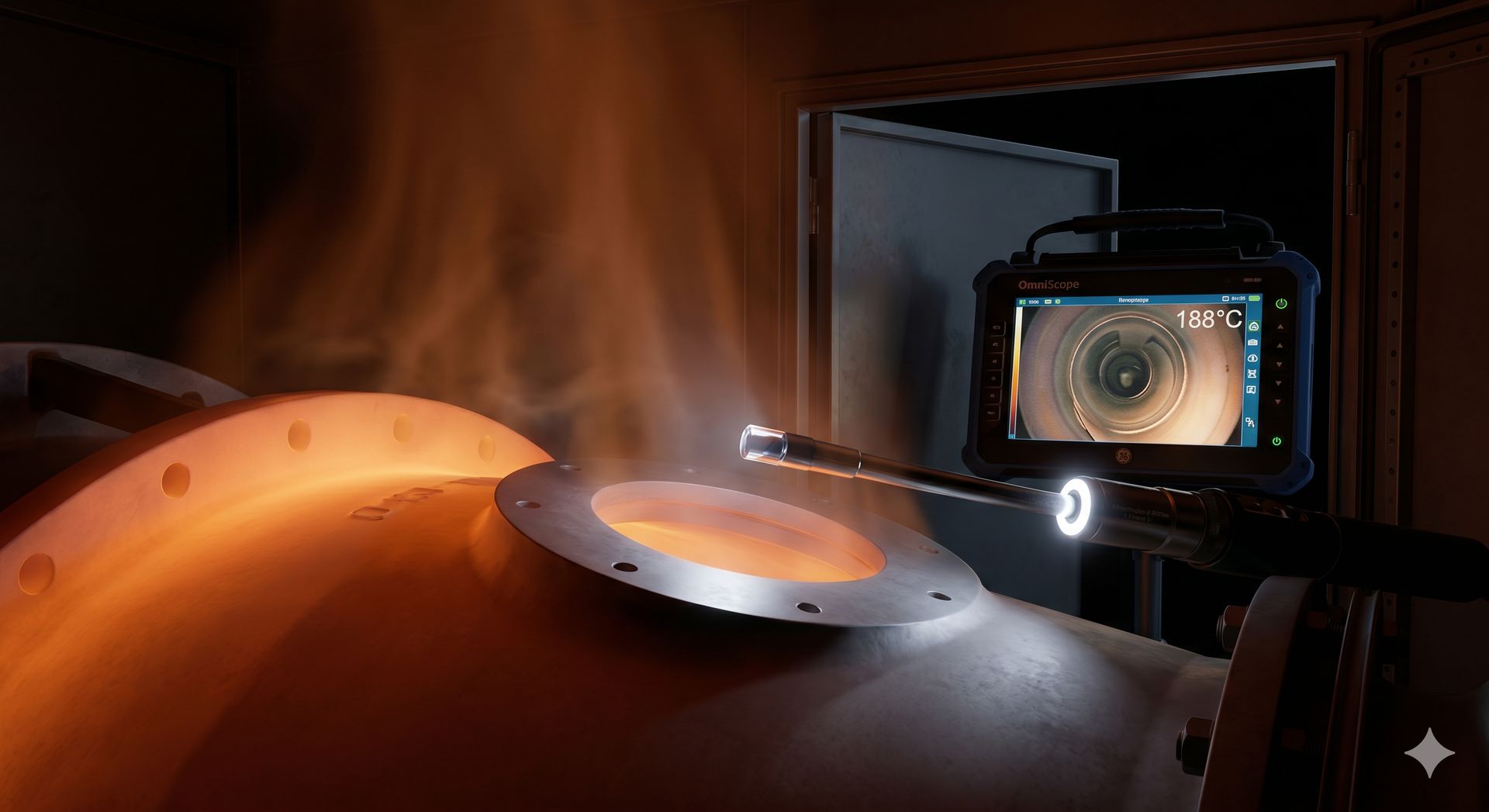
Best Practices: Optimizing Oil & Gas Turbine Maintenance with High-Temperature Borescopes
By Sugia Engineering Team
The Downtime Equation in Middle Eastern Oil & Gas
For a 500,000-barrel-per-day refinery in the Arabian Gulf, every hour of unplanned downtime carries an opportunity cost measured in hundreds of thousands of dollars. Gas-turbine-driven compressors, fired process heaters, and steam-methane reformers operate continuously, and statutory internal inspections must fit within tightly scheduled turnaround windows.
The critical constraint in hot-section borescope inspection has always been temperature. Conventional industrial videoscopes are rated to 80–100°C at the probe tip. A gas-turbine combustion section, even after a controlled cooldown from full-load shutdown, typically remains at 180–220°C for 4–6 hours. Standard practice has been to wait — and wait — until component temperatures drop below the videoscope’s rating, burning valuable outage hours with no inspection activity taking place.
The OmniScope S4: 200°C Continuous Rating
The OmniScope S4 was purpose-designed to close this temperature gap. Its 200°C continuous rating at the probe tip (with 230°C excursion tolerance for 30-minute intervals) enables inspection access 4–6 hours earlier in the cooldown cycle than conventional 80°C-rated equipment.
Three engineering features make this rating possible:
MP35N Mechanical Articulation. Conventional videoscopes use shape-memory-alloy (SMA) tension wires that lose actuation authority above approximately 120°C as the alloy approaches its austenite-finish temperature. The S4 replaces SMA wires with MP35N cobalt-nickel alloy tension cables terminated in zirconia ceramic pulleys at the probe tip, driven by external servo motors in the temperature-isolated handpiece. The mechanical drive architecture is inherently temperature-insensitive at the probe tip — limited only by the Curie point of the magnetic encoder sensors, which are rated to 250°C.
Active Sensor Cooling. A Peltier-element thermoelectric cooler maintains the CMOS sensor at ≤ 60°C even when the probe tip is immersed in a 200°C environment. Closed-loop PID temperature control with an embedded thermistor on the sensor die protects against thermal runaway.
Fused-Silica Optics. A synthetic fused-silica objective element (softening point > 1600°C) with a sapphire protective window at the probe tip maintains diffraction-limited optical performance across the full 0–200°C operating range, with less than 5 µm of focal shift.
Recommended Inspection Protocol
Based on field deployments at three Middle Eastern refineries and one combined-cycle power plant in Saudi Arabia, we recommend the following protocol for S4 high-temperature inspections:
-
Pre-insertion cooldown check. Use a non-contact infrared thermometer (FLIR or equivalent) to verify that the component surface temperature at the access port is ≤ 200°C. The S4’s integrated Type K tip thermocouple will confirm temperature upon insertion.
-
Insertion orientation. For vertical downward insertions into fired-heater convection sections, position the probe tip above the target zone and allow natural convection to establish a stable thermal gradient before articulating. This reduces thermal shock to the sapphire window.
-
Dwell-time management. Limit continuous probe-tip exposure at 200°C to 15 minutes per insertion, with a 5-minute withdrawal-and-cooldown interval. This is conservative relative to the S4’s 30-minute 230°C excursion rating, but we recommend the margin for inspection-program documentation purposes.
-
Post-inspection cleaning. Wipe the insertion tube with isopropyl alcohol after every high-temperature deployment to remove any thermally deposited hydrocarbon residue that could degrade the polyurethane jacket over repeated cycles.
Quantified Downtime Reduction
| Inspection Scenario | Conventional (80°C) Wait Time | S4 (200°C) Wait Time | Time Saved |
|---|---|---|---|
| Gas turbine hot section (GE Frame 7FA) | 5.5 h | 0.5 h | 5.0 h |
| Fired heater radiant section | 6.0 h | 1.0 h | 5.0 h |
| Steam-methane reformer tubes | 4.0 h | 0.5 h | 3.5 h |
| HRSG superheater header | 7.0 h | 1.5 h | 5.5 h |
For a typical refinery turnaround involving 4 fired heaters and 2 gas turbines, the S4 recovers approximately 40–50 hours of inspection-available time per turnaround — equivalent to extending the effective turnaround window by two full days without extending the shutdown duration.
Focus Keywords
Target Markets