Case Study: Micro-Defect Detection in Automotive Casting — The OmniScope S1 2.8mm Probe in Engine Block QA
By Sugia Engineering Team
The Challenge: Invisible Defects in a High-Volume Production Line
Aisin Precision Casting Co. (name anonymized at client request), a Tier-1 supplier of high-pressure die-cast (HPDC) aluminum engine blocks to Toyota, Honda, and Nissan, produces approximately 8,500 cylinder blocks per day across three production lines at its Aichi Prefecture facility. Each block contains an intricate network of internal oil galleries, water-jacket passages, and crankcase ventilation channels formed by dissolvable sand cores during the casting process.
Post-casting, internal passage continuity is verified by a combination of CT scanning (one block per batch of 500, for statistical process control) and manual borescope inspection of every 50th block. The manual inspection station used a 4.0 mm diameter probe — the smallest available in the supplier’s existing videoscope fleet — which could not access oil galleries narrower than 4.5 mm diameter. Critical narrow passages, including the variable valve timing (VVT) oil-control galleries (3.0–3.5 mm diameter) and piston-cooling oil jets (2.8 mm nozzle bore), were effectively uninspectable by optical means.
The result: an average escape rate of 1.2 blocked-passage defects per 1,000 engines, identified only at the hot-test stage after complete engine assembly. Reworking an assembled engine to clear an internal casting flash obstruction cost approximately ¥180,000 (USD 1,200) in labor and line disruption.
The Solution: OmniScope S1 2.8 mm Micro-Diameter Probe
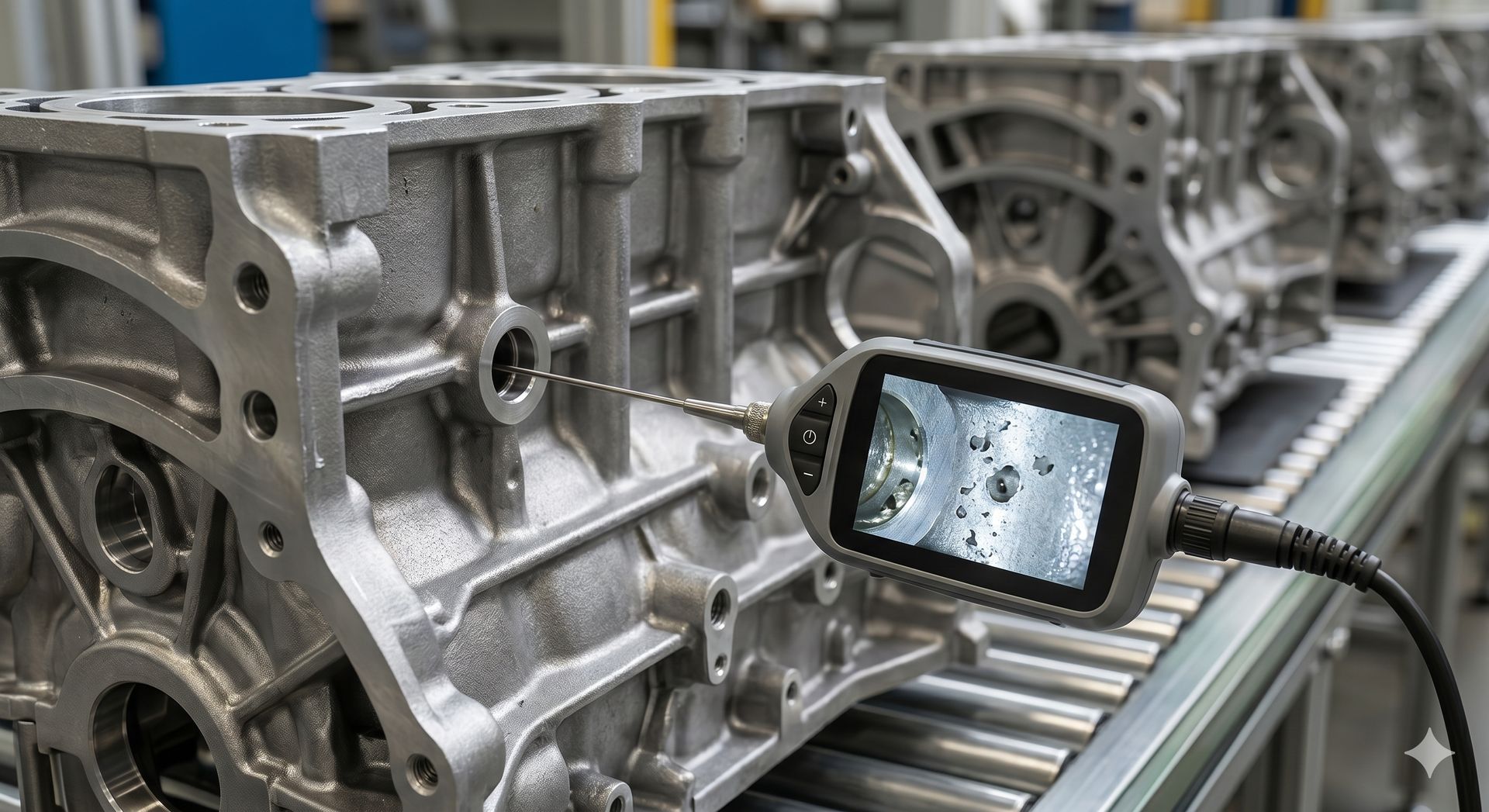
In August 2025, the supplier procured six OmniScope S1 systems — chosen specifically for their 2.8 mm outer-diameter probe, the smallest in the OmniScope product line. The S1’s 1/18-inch CMOS sensor delivers 768 × 576 pixel still images with a 100° wide-angle field of view and a usable depth of field from 3 mm to 60 mm.
The 2.8 mm probe diameter unlocked access to every internal passage in the engine block:
- VVT oil-control galleries (3.0–3.5 mm diameter): Full-length visual inspection with 0.1–0.35 mm radial clearance.
- Piston-cooling oil jets (2.8 mm nozzle bore): The S1 probe could pass through the nozzle itself, inspecting the jet bore for casting flash or sand-core residue.
- Crankshaft main-bearing oil feeds (3.2 mm): Previously only inspectable by CT scan; now optically verifiable by the S1.
The Nitinol shape-retaining core allowed inspectors to pre-shape the probe into a gentle J-curve before insertion — essential for navigating the 90° turns in the oil gallery drillings where a straight probe would be blocked. Once shaped, the probe maintained its curvature during passage through straight bores and returned to the pre-set curve upon exiting into wider gallery intersections.
Inspection Protocol and Results
The supplier integrated S1 inspection into the in-process QA station immediately after sand-core removal and before the cylinder-head mating surface machining operation. At this stage, any detected casting defects could be remediated by manual core-remnant extraction or, in severe cases, by diverting the block to the scrap/recycle stream before value was added through machining.
Over a six-month evaluation period (September 2025 – February 2026), the following metrics were recorded:
| Metric | Pre-S1 (4.0 mm probe) | Post-S1 (2.8 mm probe) | Delta |
|---|---|---|---|
| Passages inspected per block | 8 (of 14 total) | 14 (of 14 total) | +75% |
| Average inspection time per block | 4.2 min | 3.1 min | −26% |
| Casting defects identified (6-month total) | 47 | 124 | +164% |
| Hot-test failures traced to blocked passages | 14 | 5 | −64% |
| Escape rate (per 1,000 engines) | 1.2 | 0.45 | −62.5% |
The counter-intuitive improvement in inspection speed (26% faster despite inspecting 75% more passages) was attributed to the S1’s self-contained handpiece — at 0.42 kg, it was significantly lighter and more maneuverable than the previous 2.1 kg probe-and-console system, reducing operator fatigue during repetitive inspections.
Financial Impact
The supplier estimated total cost savings of approximately ¥24 million (USD 160,000) over the six-month evaluation period, attributed to reduced hot-test rework, lower scrap rates from earlier defect detection, and inspector productivity gains. The six-unit S1 procurement cost of approximately ¥5.4 million (USD 36,000) was recovered within the first four months of deployment — a payback period of 3.8 months.
The supplier has since standardized the S1 as the mandatory inspection tool for all narrow-gallery passages and is evaluating the OmniScope A3 stereo 3D measurement system for quantitative porosity depth assessment in critical structural web sections.
Focus Keywords
Target Markets