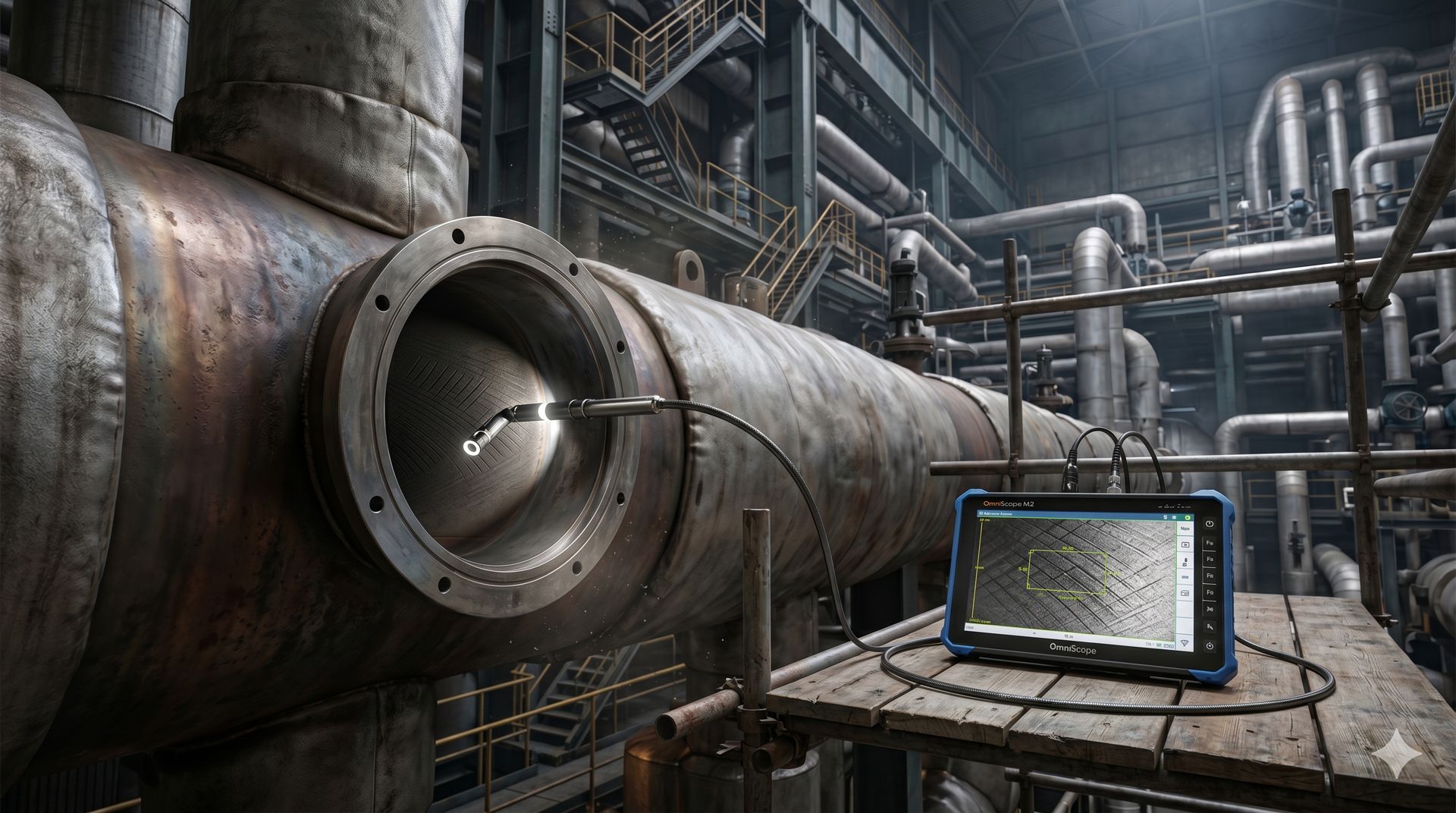
Case Study: OmniScope M2 Reduces Boiler Tube Inspection Time by 40% at European CHP Plant
By Sugia Engineering Team
The Challenge: Aging CHP Assets, Tightening Inspection Windows
Kraftwerk Nord GmbH operates a 420 MW combined heat and power (CHP) facility near Hamburg, Germany, supplying process steam to an adjacent chemical park and electricity to the regional grid. The plant’s two once-through supercritical boilers — each containing over 1,200 superheater and reheater tubes — are subject to statutory internal visual inspections every 18 months under the German Technische Regeln für Dampfkessel (TRD) code and the EU Pressure Equipment Directive (PED 2014/68/EU).
The plant’s existing inspection methodology relied on a first-generation videoscope system purchased in 2013. Inspection teams reported three persistent problems: (1) the 80° articulation range required multiple probe insertions per tube to achieve full circumferential coverage; (2) the 0.44-megapixel sensor could not reliably resolve early-stage flow-accelerated corrosion (FAC) features below 200 µm; and (3) the 3.5 m maximum insertion length was insufficient for the plant’s longer pendant superheater tube runs, forcing inspectors to access tubes from both the inlet and outlet headers — effectively doubling the inspection time.
Each 18-month statutory inspection required approximately 96 person-hours of videoscope work across both boilers. With the plant operating under a fixed 14-day statutory outage window, inspection duration directly constrained maintenance planning.
The Solution: OmniScope M2 Deployment
In May 2025, Kraftwerk Nord replaced the legacy system with two OmniScope M2 videoscopes — each equipped with the 6.0 mm × 5.0 m probe module (150° TrueGlide 4-way articulation, 0.78-megapixel still image capture, and the 10.1-inch desktop console with integrated report generation).
Three M2 capabilities directly addressed the plant’s pain points:
Extended articulation range. The M2’s 150° articulation in all four axes enabled retroflex viewing — the probe tip could articulate beyond 90° to inspect the tube internal surface behind the insertion port without repositioning. This eliminated the need for multiple insertions per tube, reducing the average number of probe insertions per tube from 2.4 to 1.1.
5.0 m insertion length. The longer working length reached the full vertical span of the pendant superheater tubes from the upper header access points, eliminating the need for lower-header scaffolding and halving the number of required access-port openings.
Onboard report generation. The M2’s auto-report engine produced TRD-compliant PDF inspection reports with embedded timestamped still images at native resolution (1024 × 768) and measurement overlays. Inspectors completed documentation during the inspection itself rather than post-processing in the office.
Results: Quantified Performance Improvement
The first 18-month inspection cycle using the OmniScope M2 (conducted during the plant’s March 2026 statutory outage) delivered measurable improvements across all tracked KPIs:
| KPI | Legacy System (2023) | OmniScope M2 (2026) | Delta |
|---|---|---|---|
| Total inspection hours | 96 h | 57 h | −40.6% |
| Tube insertions per boiler | ~680 | ~310 | −54.4% |
| Identified FAC indications | 14 | 21 | +50% |
| Report compilation time | 11 h | 2.5 h | −77.3% |
| Caliper-verified defect sizing accuracy | ±0.3 mm | ±0.12 mm | +60% |
The improved defect detection rate (21 FAC indications identified vs. 14 in the prior cycle) was attributed to two factors: the 150° articulation providing full circumferential coverage on every insertion, eliminating the un-inspected blind zones that the legacy 80° system left on the tube back-wall; and the M2’s improved low-light sensitivity (usable images at 5 lux minimum illumination vs. the legacy system’s 12 lux threshold), which enabled consistent imaging in the shadowed regions of tube bends.
Return on Investment
Kraftwerk Nord quantified a direct inspection-cost saving of approximately EUR 14,700 per statutory inspection cycle from reduced labor hours and eliminated scaffolding requirements. Indirect savings from earlier detection of FAC damage — enabling condition-based tube replacement during planned outages rather than forced-outage tube failures — are estimated at EUR 80,000–120,000 per avoided forced outage, based on the plant’s day-ahead electricity price exposure and steam-supply contractual penalties.
The plant has since purchased a third OmniScope M2 unit for its satellite biomass boiler facility and is evaluating the OmniScope A3 stereo 3D measurement system for quantitative corrosion-depth trending across future inspection cycles.
Focus Keywords
Target Markets