Industry Insights: The Future of Aviation MRO — Interchangeable Probe Platforms Reduce Fleet Costs
By Sugia Engineering Team
The Multi-Engine Challenge
A typical third-party aviation MRO facility services engines spanning multiple OEMs and generations: a CFM56-7B from a Boeing 737NG on one bay, a GE90-115B from a 777-300ER on the next, and a PW1500G from an A220 in the tear-down area. Each engine type has unique borescope access-port geometry: the CFM56 uses 4.8–5.0 mm ports on the HPC case, the GE90 requires 6.0 mm probes to navigate the larger-diameter annular combustor access tubes, and the GEnx demands 4.0 mm micro-diameter probes for its lean-burn combustor fuel-nozzle inspection ports.
Historically, MRO facilities solved this by purchasing separate videoscope systems for each probe class — one 4.0 mm system, one 6.0 mm system, sometimes a dedicated 6.1 mm HD system for high-resolution documentation. Capital equipment redundancy was priced into the inspection overhead.
The OmniScope A2: One Console, Multiple Probes
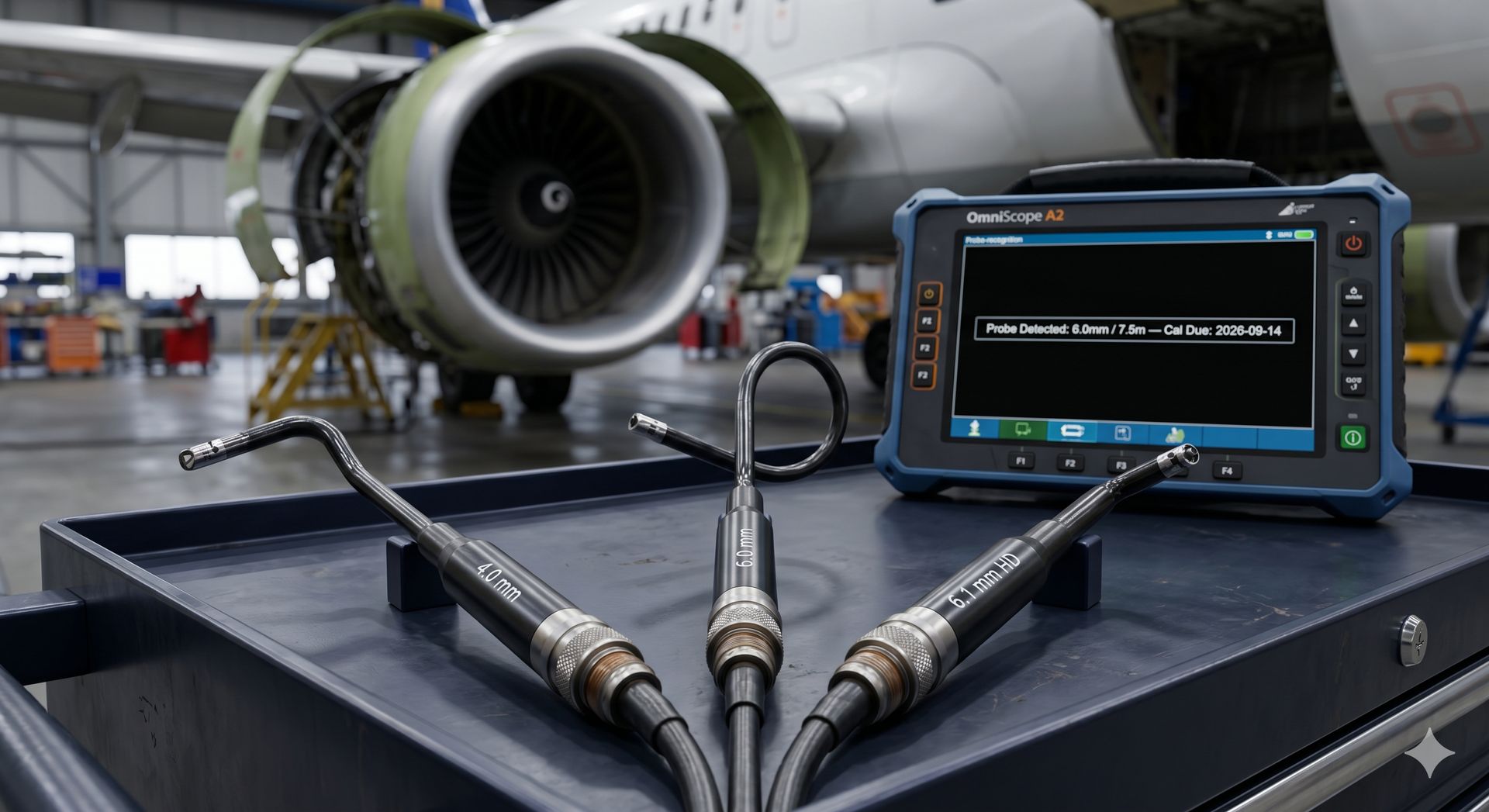
The OmniScope A2’s fully interchangeable probe architecture changes this equation. A single A2 console accepts 4.0 mm, 6.0 mm, and 6.1 mm HD probe modules — each carrying onboard EEPROM with serial number, calibration data, accumulated articulation cycles, and optical configuration. Probe swap time is under 45 seconds from disconnect to full system recognition, including automatic recall of the last-used illumination and articulation settings for that specific probe.
For an MRO facility servicing four engine families (CFM56, V2500, GE90, GEnx), the capital equipment comparison is instructive:
| Configuration | Legacy Approach | OmniScope A2 Approach |
|---|---|---|
| Consoles required | 3 (4.0 mm, 6.0 mm, 6.1 mm HD) | 1 |
| Probe modules required | 3 (fixed to consoles) | 3 (swappable) |
| Total system cost | ~$72,000 (3 × $24,000) | ~$33,000 (1 × $18,000 + 3 × $5,000) |
| Cost reduction | — | 54% |
Beyond Capital Cost: Operational Flexibility
The interchangeable architecture delivers operational benefits that compound over the equipment lifecycle:
Calibration continuity. When a probe module reaches its recommended calibration interval, only that module is removed from service and returned for calibration — the console and the other two probes remain operational. With a fixed-probe system, the entire unit is unavailable during calibration, typically 5–7 business days.
Fleet standardization. A regional MRO provider with four facilities can standardize on the A2 console across all sites while maintaining site-specific probe inventories matched to local engine-type volume. Training, spare-battery logistics, and firmware updates are unified across the fleet.
Damage isolation. Probe damage — the most common failure mode in aviation MRO videoscopes, typically from accidental impact against access-port threads or internal engine structure — is isolated to the probe module. The console remains operational with a spare probe while the damaged unit is repaired. This eliminates the single-point-of-failure risk inherent in fixed-probe systems.
Regulatory Acceptance
Both the FAA (under 14 CFR Part 145 repair station regulations) and EASA (under Part-145 and associated AMC/GM) accept interchangeable-probe videoscope systems for engine borescope inspections, provided that the probe-calibration certificate is traceable to the specific probe serial number — which the A2’s onboard EEPROM architecture inherently satisfies. The console’s automatic probe recognition, with calibration-date flagging, supports regulatory audit by ensuring that an inspector cannot inadvertently use an out-of-calibration probe module.
The Bottom Line
For an MRO facility conducting 500+ engine borescope inspections per year across three or more engine families, the A2 interchangeable architecture reduces total videoscope cost of ownership by approximately 40–55% over a five-year equipment lifecycle compared to fixed-probe alternatives, while improving inspection readiness through fault isolation and calibration flexibility.
Focus Keywords
Target Markets