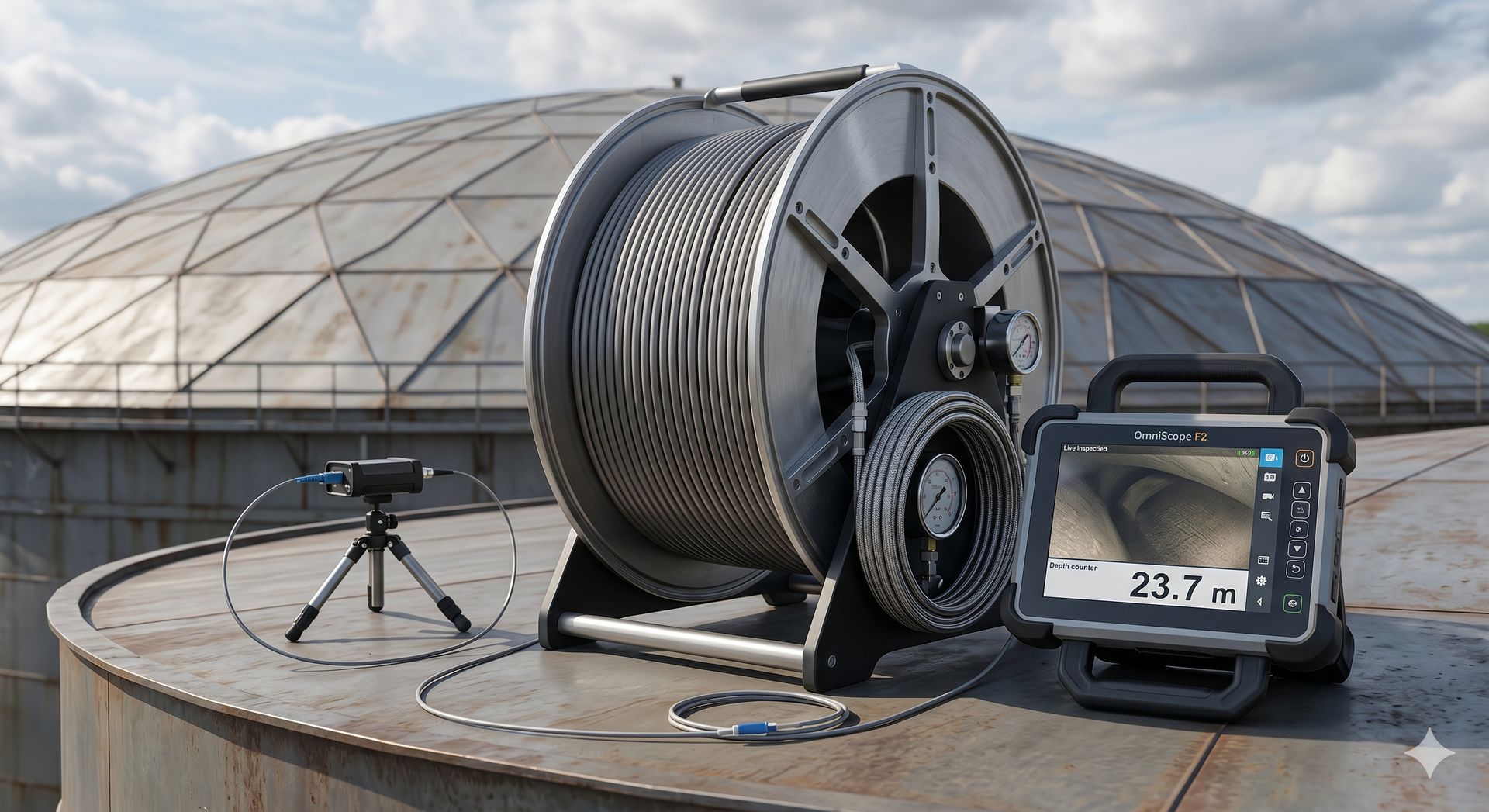
Product Launch: Breaking Boundaries — The OmniScope F2 Pneumatic 30m Borescope for Long-Pipe NDT
By Sugia Engineering Team
The Long-Reach Barrier Has Been Broken
Industrial videoscope insertion-tube length has historically been limited by a fundamental mechanical constraint: tension-wire articulation systems accumulate friction exponentially as cable length increases. A 6.0 mm probe with electro-mechanical articulation that delivers 180° tip deflection at 3.5 m typically drops to 110° at 10 m, and becomes effectively unsteerable beyond approximately 12 m. For pipeline, deep-vessel, and storage-tank inspections requiring 20–30 m of reach, the only alternative has been non-articulating crawler systems, push-rod cameras, or — in the worst case — cutting additional access ports.
The OmniScope F2 eliminates this constraint by replacing mechanical tension-wire actuation with a pneumatic articulation system. An integrated oil-free micro-compressor in the console delivers filtered compressed air at 0.8 MPa (8 bar) through a 0.8 mm pneumatic lumen integrated into the insertion tube. The probe tip houses a three-axis pneumatic actuator assembly where regulated air pressure to three paired chambers controls tip deflection in the vertical plane, horizontal plane, and an all-way blending mode for omnidirectional steering. Each axis pair operates on a push-push principle: pressurizing one chamber while venting the opposing chamber to atmosphere produces controlled tip deflection in that direction.
Why Pneumatic Articulation Is Length-Independent
The critical advantage is architectural: actuation force is generated at the tip, not transmitted through tension wires from the handpiece. Friction accumulation along the insertion tube — the dominant limitation on electro-mechanical articulation range — is irrelevant to pneumatic actuation because the air pressure at the tip is determined by the compressor output pressure minus the static pressure drop along the pneumatic lumen, which is independent of cable curvature.
The F2 maintains its full 150° articulation range across both the 20 m and 30 m insertion tube options with zero degradation. The 30 m probe achieves the same tip-deflection angle at full extension as at 1 m. This has been independently verified per ASTM E317 by a third-party NDT laboratory; the certification report is available upon request.
Key Deployment Features
Motorized Cable-Drum System. The 600 mm diameter powered drum includes a variable-speed drive (0–300 mm/s insertion rate), an integrated optical-encoder depth counter with 1 mm resolution, and an adjustable clutch for controlled manual override. The drum disconnects from the console via a MIL-DTL-38999 connector for separate transport — the console weighs 12.4 kg and the loaded 30 m drum 16.6 kg, enabling two-person carry.
Optional Fiber-Optic Transponder. For hazardous-environment deployments — confined-space entries, elevated work platforms, radiation-controlled areas — the optional transponder module separates the probe-deployment station from the operator console by up to 100 m via a single LC-duplex single-mode fiber connection. This allows the probe and drum to be positioned at the access point (e.g., on a tank roof) while the operator remains at a safe distance with the console.
Long-Reach Illumination. A 50 W LED engine in the console delivers illumination to the probe tip via a 0.6 mm fused-end polymer fiber bundle integrated into the insertion tube cross-section. Measured output at the tip is 2,000 lux at 100 mm working distance at the full 30 m probe length — sufficient for the F2’s 1.0-megapixel sensor at 75° diagonal field of view.
Target Applications
| Application | Reach Required | F2 Advantage |
|---|---|---|
| Cross-country pipeline internal corrosion | 15–30 m between valve stations | Single-access inspection without additional bell-hole excavation |
| Storage-tank floor underside | 20–40 m across tank diameter | Single roof-manway access; no side-shell entry required |
| Nuclear reactor vessel internals | 15–25 m through upper internals | Transponder enables operator separation from radiation-controlled area |
| Water-transmission tunnel inspection | 25–30 m between access shafts | Articulation maintained for lateral branch inspection |
The OmniScope F2 is available for order now, with an 8-week lead time for standard configurations. Contact our engineering team for a site-specific deployment assessment.
Focus Keywords
Target Markets